
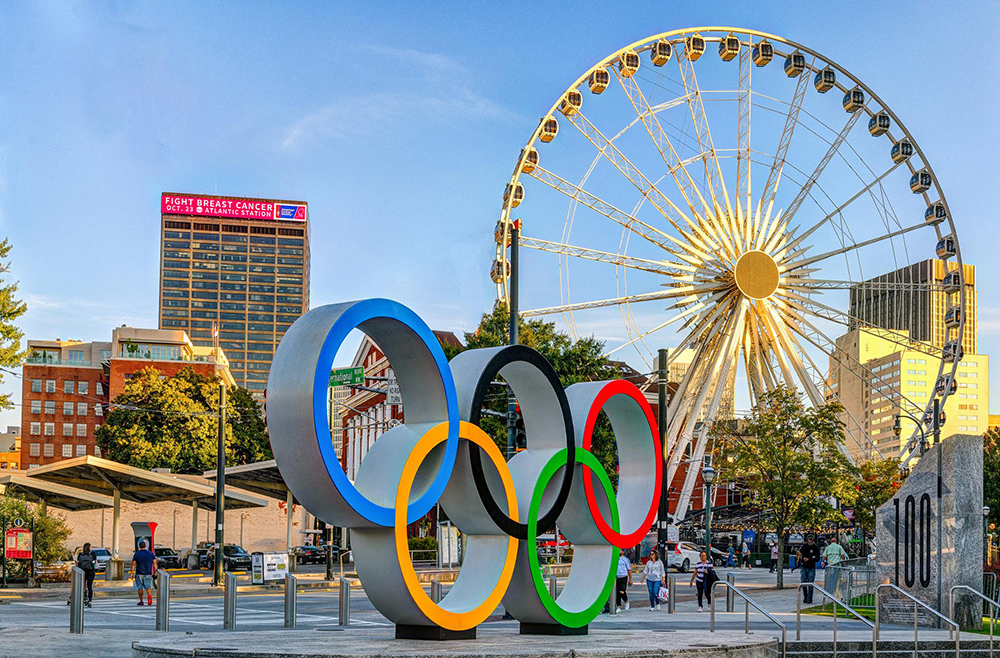
As Atlanta prepares to welcome the world for the FIFA World Cup 2026, we’re reminiscing on a summer nearly 30 years ago when the city stepped onto the global stage for the 1996 Olympic and Paralympic Games. What began as two weeks of competition became something much bigger, a blueprint for the international events Atlanta continues to attract today, with an Olympic legacy that still shapes the city in ways both visible and unexpected.
In the heart of downtown, the story of the city’s Olympic legacy begins at Centennial Olympic Park. Once an underutilized stretch of downtown, this 22-acre green space was built by the Atlanta Committee for the Olympic Games as part of the infrastructure improvements for the 1996 Summer Olympics. For me, it’s also where my own connection to Atlanta began. I’m originally from North Carolina and the first time I ever visited the city was nearly 15 years ago for the Big South Volleyball Tournament. I remember standing in Centennial Olympic Park, taking in the vast green space framed by high-rises and attractions and thinking to myself, one day, I want to live here. There was something about the energy that just stuck.
On the sidewalks and walkways, you can see the footprints of Olympians. Engraved bricks have the names of the donors and Olympic athletes who supported the park’s construction. They carry names, messages and memories from people who wanted to be part of something bigger. The park also holds space for a more solemn chapter and serves as a symbol of unity and healing. After the tragic bombing during the 1996 Olympics, the park became a place of remembrance and resilience. To this day, it continues to host concerts and community events. It’s a testament to Atlanta’s ability to come together, heal and move forward without forgetting.
Today, Centennial Olympic Park is surrounded by Atlanta’s most popular attractions, including SkyView Atlanta, Georgia Aquarium, World of Coca-Cola and National Center for Civil and Human Rights. The park has become a go-to gathering place and central hub for experiencing the city. For a deeper dive, head to the Atlanta History Center, where exhibits tell the story of how the Games came into focus not just as a global event, but as a defining turning point that propelled Atlanta onto the world stage. It includes memorabilia from athletes and fans, archival materials, vintage video footage and interactive activities.
That influence shows up in more unexpected places, too, like the racks of vintage shops in Little Five Points. In true millennial fashion, there has been a resurgence of 90s-era Atlanta Olympic apparel: windbreakers, pins, graphic tees and starter jackets that feel both nostalgic and newly relevant. Shops like Rag-O-Rama and The Clothing Warehouse have seen renewed interest in these pieces, with visitors and locals alike hunting for a piece of Atlanta history.
Atlanta’s Olympic legacy lives on in the rhythm of downtown, in the stories etched into brick and memory and in the way the city continues to show up on the world stage. You can feel it in Centennial Olympic Park, see it at the Atlanta History Center and even spot it in the vintage racks of Little Five Points. Atlanta’s Olympic spirit didn’t end in 1996. It’s still evolving and welcoming the world.